




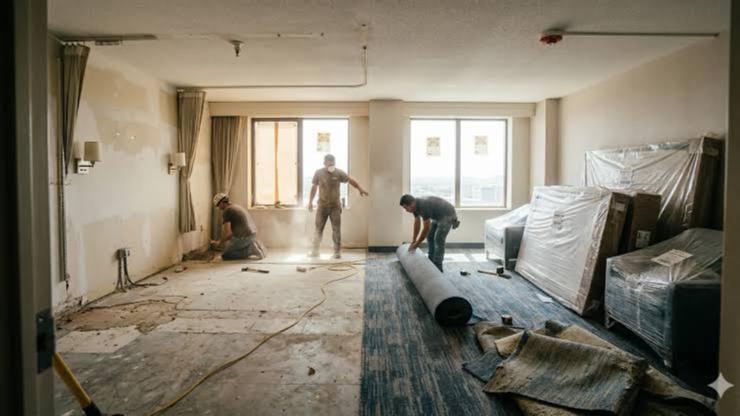
Hotel Renovation Is an Operational Event, Not Just a Capital Expense
By Dr. Ruby Dhalla
The cost of a hotel renovation is not simply the number on a contractor’s proposal. For an owner, the real cost may also include rooms removed from inventory, a schedule that runs longer than expected, change orders that were not anticipated, guest complaints caused by poor phasing, and a general manager spending too much time solving construction problems instead of running the hotel.
It may include missed revenue because finishes were not ordered on time, a permitting issue delayed installation, or a decision that should have been made during design was postponed until the contractor was already on site.
That is why one of the biggest mistakes in hotel renovation occurs before construction ever begins: treating the project strictly as a construction expense instead of an operational event.
The right question is not only, “What will this renovation cost?” It is also, “How will we execute this renovation while protecting the performance of the property?” Those are two very different conversations.
The visible and invisible budget
A renovation budget usually begins with hard costs: demolition, labor, materials, installation, and contractor overhead. But a hotel renovation also carries soft costs, including design, permitting, project management, FF&E, technology, franchise requirements, and financing expenses. Industry construction guidance estimates that soft costs can represent approximately 12% to 18% of a hotel development or renovation budget, while FF&E can represent 8% to 12% or more depending on the brand and level of finish.
The operating disruption can be even more significant. A guestroom taken out of service does not simply remove one room from the inventory count. It can reduce occupancy, compress demand into fewer available rooms, increase room moves, complicate housekeeping schedules, and force the hotel to decline business during high-demand periods.
For example, a 200-room hotel taking 20 rooms out of service for 60 days removes 1,200 room nights from potential inventory. At a $180 ADR, the theoretical gross room-revenue exposure is $216,000 before considering whether the hotel could have sold those rooms, how much demand would have been displaced, and what variable expenses would have been avoided.
The number is not a guaranteed loss, but it demonstrates why phasing and timing matter. The same principle applies to common areas. Closing a lobby, restaurant, meeting room, pool, or parking area can affect more than the revenue from that specific facility. It can reduce conversion, damage online reviews, compromise group business, and weaken the property’s ability to charge its intended rate.
Renovation economics in 2026
Renovation economics are becoming more demanding. Owners face elevated labor costs, material-price volatility, constrained trades, brand-mandated improvements, and tighter lender scrutiny. Complex renovation and adaptive-reuse projects frequently experience change orders equivalent to 10% to 20% or more of contract value, particularly where existing conditions are poorly documented.
That risk is not evenly distributed. A new-build project generally offers more control over the physical conditions. Renovation begins with uncertainty: walls may conceal outdated systems, drawings may be incomplete, and prior work may not match the plans. The older the property, the more important early investigation becomes.
Procurement is another common blind spot. FF&E procurement teams report budget overshoots of 15% to 25% in some projects because of material-price volatility and schedule drift. [cite:283] A delayed fabric, light fixture, casegood, or plumbing component can hold up an entire room sequence. In a hotel, that delay has a revenue consequence every night the room remains unavailable.
The practical implication is straightforward: procurement cannot be treated as an administrative task after design is complete. It is a critical path. Long-lead items must be identified, approved, ordered, inspected, stored, and delivered in alignment with the construction sequence.
The operational cost of poor phasing
A renovation should be planned around the hotel’s operating calendar, not only the contractor’s preferred schedule.
A property with strong weekend leisure demand may choose to concentrate disruptive work during weekdays. A business hotel may have more flexibility during weekends but limited tolerance for noise during corporate peak periods. A resort may need to avoid holidays and school breaks. A medical-market hotel may need to protect availability for families, clinicians, and visiting specialists throughout the year.
The best phasing plan answers several questions before mobilization:
- How many rooms can be removed from service at one time?
- Which floors or wings can be isolated safely?
- Can guest and construction traffic be separated?
- When will noisy work occur?
- Which amenities must remain operational?
- How will housekeeping, engineering, sales, and front-office teams adapt?
- What is the contingency plan if a room block falls behind schedule?
- Which dates should be protected from construction disruption?
These are not construction questions alone. They are revenue-management and guest-experience questions.
A hotel can technically remain open during renovation and still suffer meaningful damage. Guests may encounter dust, noise, closed elevators, limited amenities, or inconsistent service. Reviews can deteriorate quickly, and the resulting rate resistance may continue after the work is complete.
Research and industry case studies suggest that well-targeted renovations can produce RevPAR improvements of approximately 5% to 15%, depending on the market, competitive positioning, and scope. Other industry reporting indicates that renovated hotels can experience a 10% to 20% improvement in guest ratings during the first year, although results vary materially by execution quality and the starting condition of the asset.
The upside is real, but it is not automatic. A renovation creates value only when the hotel can translate improved physical product into higher rate, stronger conversion, better reviews, more repeat business, lower maintenance costs, or a more competitive position.
Protecting the hotel while building the future
The general manager and operations team must be involved from the earliest planning stage. They understand the guest journey, the service recovery burden, the limitations of the back-of-house layout, and the moments when a disruption will be most damaging.
A project that looks efficient on an architectural schedule may be unworkable operationally. For example, closing the only service elevator may appear acceptable for a short period, but if it forces housekeeping carts through guest corridors, slows room turns, and creates visible service friction, the operational cost may exceed the construction saving.
The hotel team should help establish:
- A room-release and return-to-inventory process.
- Daily construction access and noise protocols.
- Guest communication standards.
- A complaint escalation and service-recovery budget.
- Temporary signage and wayfinding.
- Protection plans for housekeeping and engineering routes.
- A weekly forecast of rooms unavailable and expected revenue impact.
- Clear authority for approving changes in the field.
The general manager should not become the project manager by default. A dedicated owner’s representative or project manager can protect the hotel’s interests while allowing the operating team to focus on the guest and the business.
Measure return, not completion
A project is not successful merely because the contractor reaches substantial completion. The real test begins after the work is delivered.
Owners should establish a pre-renovation baseline and measure performance at 30, 90, 180, and 365 days after completion. The baseline should include occupancy, ADR, RevPAR, competitive-set indexes, guest-review scores, direct-booking share, maintenance calls, energy consumption, labor hours per occupied room, and ancillary revenue.
RevPAR is calculated as occupancy multiplied by ADR. It is useful because it shows the combined effect of rate and utilization, but it should be paired with profitability measures. A hotel may increase ADR while losing margin if the renovation creates higher labor, cleaning, technology, or maintenance costs.
A more complete return framework should therefore ask:
- Did ADR improve relative to the competitive set?
- Did occupancy recover faster than expected?
- Did RevPAR index improve?
- Did guest satisfaction and online reputation strengthen?
- Did the hotel reduce maintenance or energy expenses?
- Did the renovation improve direct bookings or repeat stays?
- Did the asset’s stabilized NOI increase?
- Was the increase sufficient to justify the capital and disruption?
The owner should distinguish between defensive capital and offensive capital. Defensive capital preserves brand compliance, safety, and competitiveness. Offensive capital is intended to create new revenue or reduce operating costs. Both may be necessary, but they should not be evaluated using the same return expectations.
The CEO’s view
After decades of commercial renovations, one conclusion is difficult to avoid: planning, phasing, procurement, and communication with hotel operations can matter as much as the work happening in the field.
A contractor can deliver the physical scope on budget and still leave the owner disappointed if the hotel lost too much revenue, damaged its reputation, or missed the high-demand period that was supposed to fund the renovation. Conversely, a project can appear expensive on paper but produce an excellent return when it protects inventory, improves rate position, strengthens guest reviews, and reduces long-term operating friction.
The smartest owners do not ask only whether the renovation is affordable. They ask whether the hotel can absorb the disruption, whether the scope addresses the market’s real needs, and whether the organization has the discipline to execute the plan.
A renovation is therefore not simply a construction project. It is a temporary operating model, a guest-experience challenge, a procurement exercise, a capital-allocation decision, and a test of leadership.
The contractor’s proposal is only the first number. The real cost is what happens to revenue, reputation, operations, and asset value before, during, and after the work.
That is why the best hotel renovations are designed twice: once on paper, and once around the business that must remain open while the future is being built.