





Why do most Americans favor hotels over Airbnb for holiday travel?
Because Predictability and Trust Always Win
David Zaltzman
In the world of business, we are constantly told that disruption is the only path to survival. We celebrate the platforms that upend industries, applauding novelty and the ability to connect buyers and sellers in new ways.
Yet, a closer look at consumer behavior during moments of high stakes, like critical travel periods, reveals a profound strategic lesson: when reliability truly matters, the market defaults to trust, standardization, and transparency.
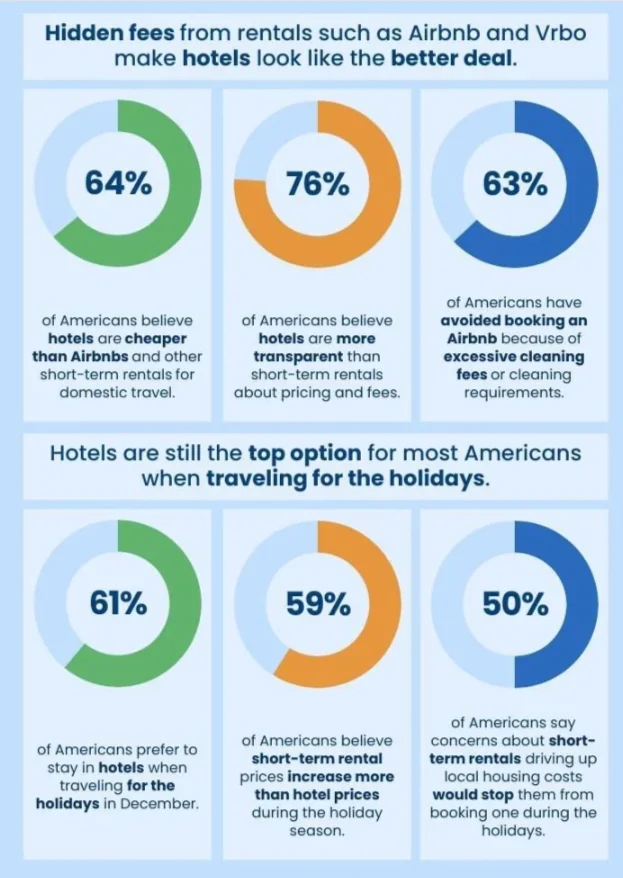
While platforms like Airbnb and Vrbo represent modern disruption in lodging, recent data shows that a significant majority of travelers are actively choosing traditional hotels. This isn’t a matter of preference for an older model; it’s a calculated business decision by the consumer.
The implications for every entrepreneur and executive, regardless of your industry, are crystal clear.
Strategic Lesson 1: The Trust Premium in Standardization
For many travelers, the primary drivers for choosing a hotel are guaranteed amenities and a predictable experience. When the stakes are high, a critical business trip, a major family event, or the busy holiday season, customers overwhelmingly opt for the provider that promises a known, standardized outcome.
For Your Business:
Novelty is great for gaining attention, but predictability is essential for retaining market share. If your product or service is complex, inconsistent, or highly reliant on individual performance, you will lose the most valuable, high-stakes contracts to a competitor with a robust, standardized operating procedure (SOP) and a trusted brand promise.
Ask yourself: When my client needs guaranteed success, are they defaulting to my competitor because my solution, while innovative, feels too variable?
Strategic Lesson 2: Transparency Trumps Price
Perhaps the most potent finding is the consumer revolt against hidden costs. A large majority of travelers perceive hotels as being both cheaper and dramatically more transparent about pricing and fees than short-term rental platforms.
This is a critical insight for the modern economy, which often relies on complex pricing models or optional add-ons. Even if your initial advertised price is lower than the competitor’s, any pricing structure that relies on surprise fees, mandatory rules (like extensive cleaning checklists), or non-negotiable complexity instantly erodes customer trust and perceived value.
The Executive Mandate:
Non-transparent pricing is a short-term trick, not a long-term strategy. Your customers are sophisticated and demand clarity. Over three-quarters of consumers in this study indicated a preference for transparent pricing. If you are masking the total cost of ownership or service through convoluted contracts or fine print, you are not saving money, you are manufacturing distrust. Transparency is the new currency of value.
Strategic Lesson 3: The Value of Low-Friction Convenience
The final key driver for traditional hotels is the assurance of easy booking and cancellation policies. This speaks directly to the imperative of delivering a low-friction customer experience (CX).
In a world where time is the ultimate non-renewable resource, the effort required to transact becomes a key part of the total cost. If your product requires tedious onboarding, difficult service navigation, or punitive cancellation procedures, you are adding cognitive load to your customer.
The Takeaway:
Modern business strategy must focus on reducing the friction of engagement. Simple, automated, and forgiving policies, from purchasing to returns, are not merely customer service features; they are core competitive advantages. When two options deliver similar quality, the one that makes the transaction effortless always wins. It’s called The Resilience of Reliability.