




The Hotel Is Not a Place to Sleep Anymore. It’s a Place to Belong
Dr Ruby Dhalla
Across North America, a structural shift is rewriting the hotel’s fundamental value proposition. The room is no longer the product. The community is.
For most of the 20th century, the hotel was a transaction. You needed a bed, a towel, and a telephone. The lobby was a choke point to get through, not a place to linger. The restaurant was the thing you defaulted to when room service felt lazy. Guests arrived, slept, and left, often without exchanging a single meaningful word with another human being on property.
That model is over. Not disrupted, over. What’s replacing it is something far more interesting, and far more lucrative: the hotel as a community node. A place where guests and locals, remote workers and road warriors, brunch crowds and board meetings converge in the same square footage. For executives building, investing in, or partnering with hospitality assets, this isn’t a soft trend about “experience.” It’s a hard structural shift in how hotels generate revenue, build loyalty, and defend against commoditization.
The lobby reclaimed but this is the death of the check-in desk
Walk into a Hilton, a Graduate, or an Ace Hotel on a Tuesday morning and you’ll struggle to identify who is a guest and who isn’t. Freelancers with laptops commandeer low sofas. A startup team occupies the communal table by the window. A retiree reads a newspaper under the chandelier. The lobby has been consciously remixed as what sociologists call a “third place”, neither home nor office, but the charged social middle ground between the two.
This isn’t a design whim. Hotels that treat the lobby as a revenue-generating community space report higher average daily rates and stickier repeat business than those that treat it as a decorative anteroom. The logic is simple: local foot traffic validates the property to travelers. When a business traveler walks into a lobby buzzing with locals having lunch, it signals that the hotel is woven into the neighborhood’s fabric, not parachuted onto it. That signal is worth real money.
“The fastest route to a guest’s heart is straight through the city’s soul. Local activations flip a box of guestrooms into a clubhouse.”
Mychal Milian, Hotel Management Strategist
Food & beverage: From amenity to engine
Nothing better illustrates the community pivot than what has happened to hotel food and beverage. For decades, the hotel restaurant was the option guests chose when it was raining and they couldn’t be bothered to walk outside. The aspiration was edible. The ambition was break-even. Today, that math has been reversed.
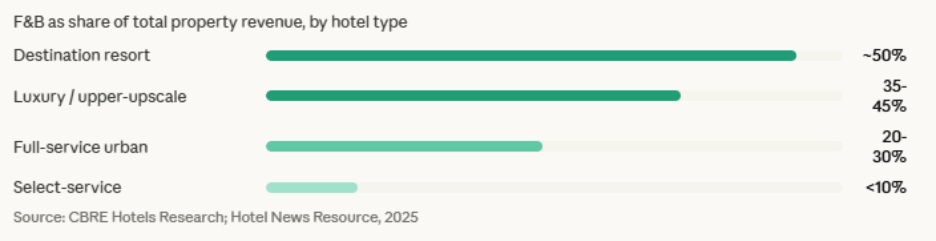
According to CBRE’s analysis of 2,669 U.S. full-service and resort properties, F&B revenue per occupied room grew 3.8% in the first half of 2025, outpacing total hotel revenue growth of 3.0% over the same period. In luxury and resort properties, F&B now accounts for between 35% and 45% of total property revenue. and in some destination resorts, approaches 50%. The hotel restaurant has stopped being a line item and started being a flagship.
The most successful operators have stopped thinking about their restaurant as a hotel amenity and started thinking about it as a standalone destination that happens to sit inside a hotel. Rooftop bars now compete for Michelin-adjacent press coverage. Chef-in-residence programs generate earned media. Brunch menus are written for the local population, not the business traveler. The economics follow: a hotel restaurant that draws neighborhood regulars creates a revenue stream largely independent of occupancy, the holy grail of hotel finance in a softening rooms market.
Notably, the “mindful drinking” movement is reshaping bar programs. Beverage revenue at hotel venues has been flat year-over-year in 2025, while low-alcohol and mocktail offerings are becoming table stakes rather than novelties. Smart operators are treating this not as a headwind but as a creative brief: premium zero-proof cocktails carry strong margins, attract a broader audience, and position the hotel as culturally attuned.
The bleisure traveler and the coworking conversion
The post-pandemic workforce handed hotels a structural gift: the normalization of remote and hybrid work has created a vast population of people who need neither a traditional office nor a home desk, they need somewhere interesting in between. Hotels, with their existing infrastructure of fast Wi-Fi, comfortable seating, ambient energy, and plentiful coffee, are the natural beneficiaries.
This “bleisure” overlap, business blended with leisure, is now a primary design brief at every hotel opening of note in North America. Co-working areas with ergonomic seating, private phone booths, and daypass access are appearing across the full-service and lifestyle segments. Hilton’s own internal data noted a significant rise in “frolleagues”, colleagues who are also friends, traveling together for team-building purposes, with 25% of business travelers expecting to travel for team building in 2025 alone. Hotels that position their public spaces as an extension of the modern workplace are capturing this demand with minimal incremental capital expenditure.
Five operating signals of the community-first hotel
- Lobby programming: live music, art installations, pop-up markets, events designed for local residents, not just guests
- Restaurant positioned as a neighborhood destination with its own identity, brand, and local press profile
- Daypass and co-working memberships monetizing public space beyond occupied rooms
- F&B menus that reflect local sourcing, local chefs, and local dietary culture rather than generic “international” fare
- Measured community KPIs: local foot traffic, neighborhood social media mentions, non-room F&B revenue as % of total
The investment case: Why this matters beyond hospitality
For investors and operators, the community model solves a problem that has plagued hotels for decades: sensitivity to occupancy cycles. A hotel that generates meaningful F&B revenue from local diners, hosts weekly events for neighborhood residents, and operates as a co-working venue during the day is insulated – partly – from the swings of transient travel demand. In an environment where RevPAR growth has decelerated to roughly 1–2% in major U.S. markets, ancillary revenue diversification is no longer a nice-to-have. It is the strategy.
The numbers support the argument. According to AHLA’s 2025 State of the Industry, total hotel-generated federal taxes are expected to exceed $30 billion in 2025, and the sector will directly employ over 2.17 million people. These are civic-scale numbers. Hotels that lean into their community role are not just capturing more revenue, they are positioning themselves as essential local infrastructure, which has implications for zoning, municipal relationships, and long-term asset value.
The smartest hotel companies have understood this for years. The Hoxton’s entire brand premise is a lobby you actually want to hang out in. Graduate Hotels builds its identity entirely around the culture of the university neighborhoods they inhabit. ACE Hotel threw open its doors to the creative community and found that the community stayed, not just as visitors, but as repeat guests and brand evangelists. What looked like cultural programming turned out to be one of the highest-ROI customer acquisition strategies in the sector.
The room is still where the guest sleeps. But it is no longer why they chose the hotel.
Consider this takeaway
Whether you are evaluating a hotel investment, negotiating a corporate travel program, or considering a hospitality asset as part of a mixed-use development, the fundamental question is the same: does this property have a reason to exist beyond the inventory of beds? The answer should now be yes, and that reason should be rooted in the community it serves
The hotels that will outperform in the next decade are not the ones with the most rooms, the shiniest loyalty app, or the most aggressive pricing algorithm. They are the ones that know their neighborhood’s name, and have made sure the neighborhood knows theirs.